Our History
Stagecraft and costuming are theater arts that can pass from generation to generation in Italian families, and in the finest tradition of that culture, the New York-based Stivanello Costume Company recently celebrated its one hundredth anniversary. Three generations of Stivanellos have headed the firm, and they also own Italy’s oldest theatrical scenery company, the Sormani studio of Milano, which was founded in 1838, one year before young Giuseppe Verdi produced his first opera at Teatro alla Scala. Serving La Scala and other important theaters, this company passed from one Sormani generation to another until Ercole Sormani sold it to the Stivanellos in 1984.
Taken together, the two firms hold an enormous inventory. The Stivanello Costume Company owns more than 100,000 costumes and the sets for 150 operas, while the Sormani studio has sets for over 600 productions. These include multiple sets for the most frequently performed works. The major companies of Vienna, Barcelona, Monte Carlo, Palermo, and Madrid are among the many served by the Sormani studio. The Stivanellos and the Sormanis have also provided the settings for many important public events. In Italy, the Sormanis set stages for patriotic and religious celebrations and even for royal weddings. They also perfected the technique for sheathing building sites and scaffolding with huge flats depicting Renaissance statues and other gigantic figures. Some of these flats are five stories high. Most impressive of these were those that hid reconstruction of historic buildings in Milano’s Piazza del Duomo at the turn of the Millenium.
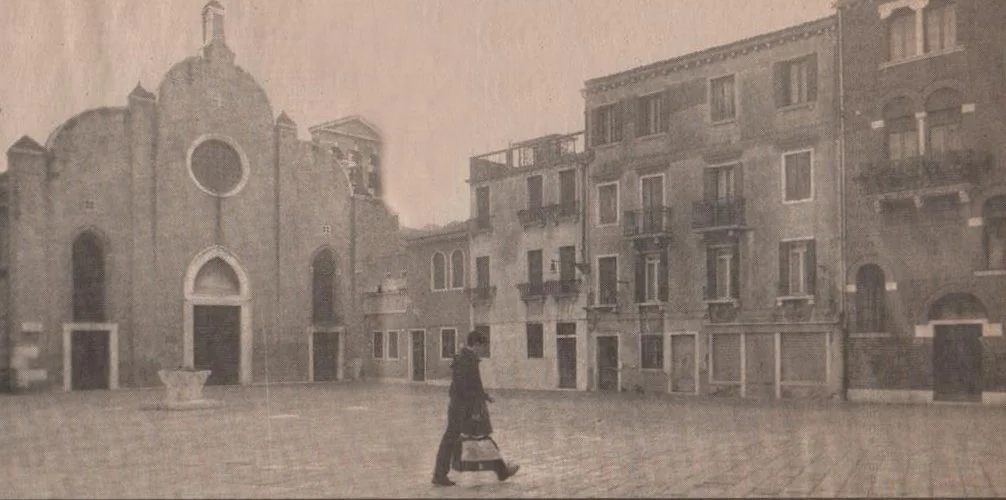
San Giovanni in Bragora
For the last century, the Stivanellos have worked with over a hundred opera companies in the United States, Canada, Mexico, Cuba, Puerto Rico, Venezuela, and Chile. These include Philadelphia, Pittsburgh, Chicago, Milwaukee, Baltimore, Miami, Hartford, Providence, New Haven, Tulsa, San Antonio, St. Louis, Washington, Cincinnati, and dozens of smaller cities. In many places, they actually helped to found the opera companies. They also dressed and provided sets for Italian-American religious processions and passion plays and for The Romance of a People, the colossal Jewish historical pageant of 1933-1934. This played in many American cities before audiences of over 20,000 in stadiums and halls such as Soldier Field in Chicago. They staged and costumed the first Opera Cameos on television. Additionally, their sets and costumes have been used in films such as Illuminata, Harlem Aria, and The Secret Lives of Dentists. Their costumes have been displayed in several opera exhibits, the windows of Macy’s flagship store in New York, and at the Metropolitan Opera house in Lincoln Center.
The Stivanello Costume Company is solidly grounded on eight generations of the clan’s enterprises, starting in the 1600s, when this family emigrated from Vicenza to Venice. By the 1740s they had settled into the tiny parish of San Giovanni in Bragora, where the Vivaldis were their neighbors. Agostino Stivanello, founder of the American firm, was born in Venice in 1879. His first wife, Eugenia Privato, was descended from singers who performed in several Venetian theaters from the 1760s to the 1790s; but her most illustrious ancestor was Antonio Codognato, a celebrated Venetian scenic designer and theater architect. Codognato was called “The Mirror Man” because he used such amazing special effects. In 1753, the gorgeous mirrors he chose for Baldassare Galuppi’s Il Mondo alla Roversa at the Teatro San Samuele created such a furor that the impresario opened the house during the day and charged admission to display the set on an empty stage. If people wanted to see the opera, they had to come back at night and pay again. This was surely a unique event in theater history. Codognato worked in Venice for more than fifty years, dying there in 1808. He also restored the historic Teatro San Giovanni Crisostomo, which is now called the Teatro Malibran.
By marrying the daughter of a Codognato, Agostino Stivanello, a grand gentleman and passionate opera lover, came gradually into the opera business. He and Eugenia named four of their children after opera characters: Elvira after the heroine of Ernani, Antonio Lionello after Lionel in Martha, Amelia from the soprano in Un Ballo in Maschera, and Giovanna from Giovanna d’Arco. Their fifth child, Eugenio Armando, was named for Marguerite Gautier’s lover in La Dame aux Camélias. When Eugenia died in 1910, Agostino was left a widower with these small children. His second wife was Beatrice Bernardi, an opera singer who had won her reputation in Venice and all across the Veneto. In the middle of World War I, Agostino managed to get to New York and in the early 1920s, he settled his wife and children to New York. Soon after his arrival, Agostino met Enrico Caruso, Geraldine Farrar, Titta Ruffo, Maria Jeritza, Giovanni Zenatello, and Giovanni Martinelli, among many other singers.

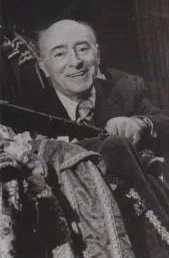
From left to right: Tony Stivanello, Agostino Stivanello, Eugene Stivanello
In 1924, Agostino founded his costume company with the help of two partners and an Italian-American theatrical lighting expert. Passionately Venetian, he chose the flag of Venice for his logo. The company began by furnishing costumes for productions in the old Thalia Theatre, the Fourteenth Street Theatre, and the Hippodrome. Soon, Tony (Antonio) Stivanello, Agostino’s oldest son, began working at his father’s side, fitting, packing, and unpacking costumes and painting and hanging scenery.
Tony began his career as a stage director in 1933 in Lohengrin, when he rescued the season of the Cincinnati Summer Zoo Opera. He continued there for 25 years, one of the highlights being creating a unique staging for Marjorie Lawrence in Aïda.
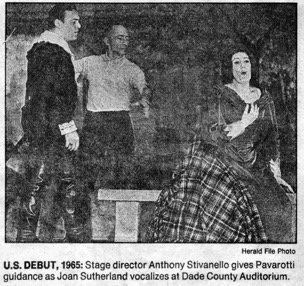
Tony’s career spanned more than sixty years, earning him honors and a couple of titles. In Opera News in 1962, he was “The Compleat Director” and in Newsweek in 1974, he was “Mr. Instant Opera.” A perfectionist, Tony was a dynamic, restless man who rarely slept. He worked through decade after decade, costuming and mounting more than 100 productions annually. He also had an illustrious career as a stage director in well over a thousand productions, including those that did not involve his costumes and scenery. In addition to his father’s famous colleagues, Tony worked with de Luca, Zenatello, Martinelli, Castagna, Gigli, Flagstaff, Ponselle, Milanov, Albanese, Pons, Nilsson, de Stefano, Tagliavini, Björling, Del Monaco, Warren, Moffo, Tucker, Peerce, Corelli, Tebaldi, Kirsten, Peters, Sutherland, Merrill, Domingo, and Pavarotti, to name just a few of the stars who have sung on his stage. Pavarotti made his US debut with Tony Stivanello and credits him in his autobiography.
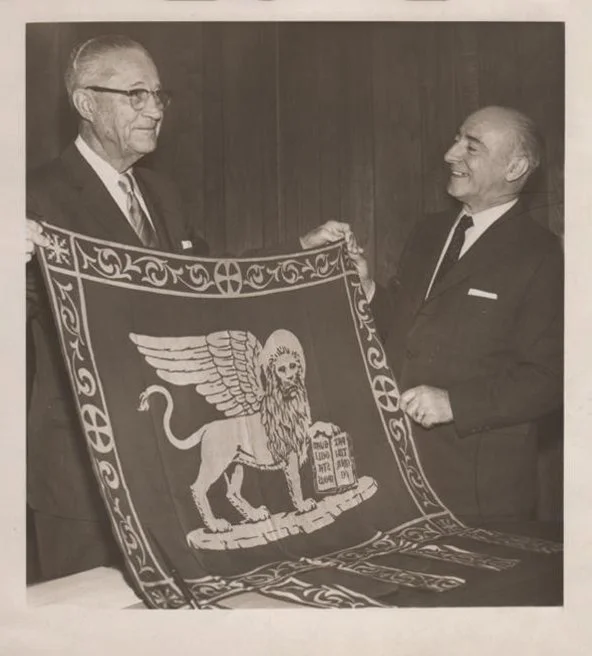
Tony Stivanello (right) with the Venetian flag.
When Giacomo Puccini was composing Turandot, he commissioned an Italian company to produce a set of gongs to produce the particular sound of ancient China that he was imagining. These were the only gongs that ever existed. Tony won them in a bet and brought them to the United States to use whenever he directed Turandot. He finally sold them decades later to someone he trusted so they could be used by everyone else, and other productions would finally be musically authentic. This tale was featured on the television series Strange Inheritance.


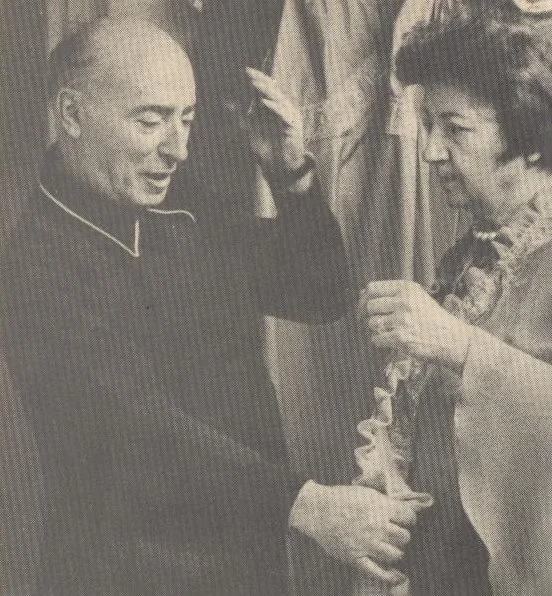
Tony Stivanello working with a seamstress.
Tony continued directing through the 1980s and finally went to that great big theatre in the sky. See Obituary in Opera News.
Opera, though, is the lifeblood of the Stivanellos. The eighth generation of this theatrical family made its debut in 1999, when Victoria Stivanello, Roberto’s daughter, appeared onstage as Dolore in Madama Butterfly. In her brief career, she also appeared in Tosca, La Bohème (both Puccini’s and Leoncavallo’s), and Turandot in New York’s Central Park. Those were special moments for the family, as three Stivanello generations were part of those productions. Roberto staged them, and Yolanda sang in the chorus.
As Stivanello Costume Company celebrated its Centennial in 2024, the family contemplated a future ninth generation. Roberto already committed the sacrilege of marrying a “civilian.” His wife Anne is a nurse. But she has, to her credit, appeared in some operas as a super. Victoria is a chemical engineer – another civilian. Perhaps one of her children will carry on the tradition and be the ninth generation.
Tony passed the direction of the Stivanello Costume Company to his son Roberto. With it he also passed on his two greatest passions, opera and baseball. When Tony taught staging to Roberto, he taught his son to respect the music of his art. Of his art, Roberto says, “When I stage an opera, I do the reverse of what happens with motion pictures. First the movie gets filmed, then they add the music. But with opera, we already have the music, and therefore the drama. So I plot the movement to the music. The music comes first.” Dedicated and serious, Roberto is as devoted to opera as his father and grandfather were.
Not everyone in the clan is in theater. Attilio Codognato, a Stivanello cousin who remained in Venice, served Europe’s blood royalty and richest families. A celebrated jewelry designer, he displayed treasures of gold and hundreds of glittering diamonds in his shop window at the entrance to Piazza San Marco and in vitrines in the famed Hotel Cipriani. The Duchess of Windsor and Princess Grace of Monaco were among his favorite clients; out of discretion, he would decline to name the others he worked with.
Once in America, the Stivanello family’s Venetian roots began to branch out. Tony’s wife, Yolanda Antoine, is of Hungarian descent. Of course, they met when Yolanda was singing in a production Tony was staging. Yolanda Antoine is a veteran of several hundred performances as a chorister as well as a comprimario. She has sung on stages all over North and South America. Yolanda’s father, Antoine Oberding, was the head of the costume department at the Metropolitan Opera. Her mother, Rose Oberding, also worked with costumes, mostly on television. Her brother, Robert Antoine, sang in opera children’s choruses in both Chicago and New York. He also appeared in major roles on Broadway before he became an architect. One of Robert’s young children, Damian Oberding, was at a production when he was a child. Next thing he knew, he was being rushed backstage and dressed very quickly as Butterfly’s son when the original boy got frightened and refused to stay. Poor Damian had no idea what happened to him. But years later he admitted it was fun.